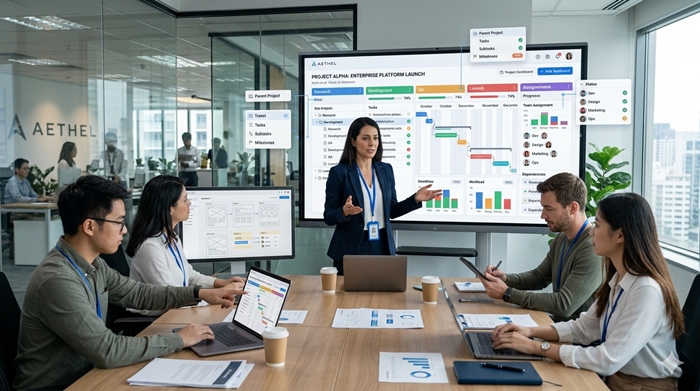
In today's competitive business environment, managing projects is no longer as simple as assigning a few tasks and expecting results. Modern organizations handle multiple departments, teams, clients, deadlines, and objectives simultaneously. Without a structured system, projects quickly become chaotic, communication breaks down, and productivity suffers.
This is where Multi-Level Project Management becomes a game-changing strategy.
High-performing teams don't simply manage projects; they manage projects at multiple levels. They divide large goals into manageable phases, organize tasks into logical hierarchies, assign responsibilities clearly, and monitor progress continuously.
Organizations that embrace multi-level project management consistently outperform their competitors because they maintain visibility, accountability, and efficiency throughout the project lifecycle.
GoToTask helps businesses implement this approach through powerful project management, task assignment, and team collaboration features designed to keep every team member aligned and productive.
Understanding Multi-Level Project Management
Multi-Level Project Management is a structured method of organizing projects into multiple layers of work.
Instead of treating a project as one large activity, it is broken down into:
- Main Projects
- Project Phases
- Departments
- Sub-Projects
- Tasks
- Subtasks
- Team Responsibilities
- Progress Tracking
This hierarchical approach allows organizations to maintain control over complex workflows while ensuring every team member understands their responsibilities.
For example, imagine a company launching a new website.
Traditional project management may create a single project called:
"Website Development"
Multi-level project management would divide it into:
Project: Website Development
Phase 1: Planning
- Requirement Gathering
- Competitor Research
- Wireframe Design
Phase 2: Design
- Homepage Design
- Inner Page Design
- Mobile Design
Phase 3: Development
- Frontend Development
- Backend Development
- Database Setup
Phase 4: Testing
- Functionality Testing
- Security Testing
- Performance Testing
Phase 5: Launch
- Deployment
- Monitoring
- Optimization
Each level can then contain tasks, subtasks, deadlines, and assigned team members.
This structure dramatically improves project visibility and execution.
Why Traditional Project Management Fails
Many businesses still use spreadsheets, WhatsApp messages, emails, and manual follow-ups to manage projects.
Common problems include:
Lack of Visibility
Managers cannot see:
- Who is working on what
- Task completion status
- Delayed activities
- Project bottlenecks
Communication Gaps
Information gets lost across:
- Emails
- Calls
- Messages
- Meetings
Unclear Ownership
Employees often assume someone else is responsible for a task.
This results in:
- Missed deadlines
- Delayed deliverables
- Client dissatisfaction
Difficulty Scaling
As organizations grow, manual systems become impossible to manage efficiently.
Multi-level project management solves all these challenges.
Benefits of Multi-Level Project Management
1. Better Project Organization
Large projects become easier to understand and execute.
Teams can focus on smaller tasks while management monitors the bigger picture.
This reduces confusion and increases efficiency.
2. Improved Accountability
Every task has:
- An owner
- A deadline
- A priority level
Team members know exactly what is expected of them.
Managers can easily identify pending tasks and performance gaps.
3. Faster Decision-Making
Real-time project visibility helps leaders make informed decisions quickly.
Instead of waiting for status meetings, managers can instantly view:
- Task completion rates
- Team workloads
- Delayed activities
- Resource allocation
4. Enhanced Collaboration
Successful projects require teamwork.
Multi-level project management encourages collaboration by allowing:
- Shared project visibility
- Task comments
- Progress updates
- Department coordination
Everyone remains aligned toward common goals.
5. Reduced Project Delays
Project delays often occur because teams discover problems too late.
Structured project tracking helps identify risks early.
Managers can intervene before delays affect delivery schedules.
The Role of Task Assignment in Project Success
Task assignment is one of the most critical elements of project management.
Without proper assignment:
- Work gets duplicated
- Tasks remain unfinished
- Deadlines are missed
High-performing teams follow clear assignment principles.
Assign Tasks Based on Expertise
Employees should receive tasks aligned with their skills.
For example:
- Designers handle creative tasks.
- Developers handle coding.
- Content writers create content.
- QA teams perform testing.
Define Clear Expectations
Every assigned task should include:
- Description
- Objective
- Deadline
- Priority
- Dependencies
Clear expectations reduce misunderstandings.
Monitor Task Progress
Managers should continuously monitor:
- Completed tasks
- Pending tasks
- Overdue tasks
- Team workload
GoToTask provides centralized task assignment and monitoring capabilities that make this process simple and transparent.
Why Team Collaboration Determines Project Success
A project is only as strong as the collaboration behind it.
Even highly skilled employees struggle when communication is poor.
Common Collaboration Challenges
Businesses frequently experience:
- Information silos
- Duplicate work
- Missed updates
- Delayed responses
These issues slow project execution.
Creating Collaborative Teams
High-performing organizations encourage:
- Transparent communication
- Shared objectives
- Progress visibility
- Cross-functional cooperation
Employees become more engaged because they understand how their work contributes to overall project success.
Collaboration Through Technology
Modern project management platforms provide:
- Shared dashboards
- Notifications
- Team discussions
- Activity tracking
This creates a unified workspace where everyone stays informed.
How Multi-Level Project Management Improves Team Performance
Increased Productivity
Employees spend less time searching for information and more time completing meaningful work.
Better Resource Utilization
Managers can balance workloads effectively.
This prevents:
- Employee burnout
- Underutilization
- Resource conflicts
Improved Quality
Structured workflows reduce mistakes and improve consistency.
Quality checks can be incorporated into every project phase.
Stronger Accountability
Everyone knows:
- Their responsibilities
- Deadlines
- Performance expectations
This naturally improves execution.
Greater Transparency
Leadership gains complete visibility into project health.
Decision-making becomes data-driven rather than assumption-based.
Essential Features of an Effective Multi-Level Project Management System
A successful platform should provide:
Project Hierarchy
Ability to create:
- Projects
- Sub-projects
- Tasks
- Subtasks
Task Assignment
Assign responsibilities to specific team members.
Progress Tracking
Monitor task completion in real time.
Priority Management
Identify urgent and critical tasks.
Team Collaboration Tools
Enable communication directly within projects.
Reporting Dashboard
Provide insights into:
- Team performance
- Project status
- Resource utilization
- Completion rates
How GoToTask Supports High-Performing Teams
GoToTask is designed specifically for organizations seeking complete project visibility and control.
Multi-Level Project Management
Create structured project hierarchies for better organization.
Smart Task Assignment
Assign tasks with deadlines, priorities, and ownership.
Team Collaboration
Keep communication centralized and project-focused.
Real-Time Monitoring
Track progress instantly from a single dashboard.
Productivity Analytics
Measure team performance and identify improvement opportunities.
Scalability
Whether you manage five employees or five hundred, GoToTask scales with your business needs.
Best Practices for Implementing Multi-Level Project Management
Start with Clear Objectives
Define project goals before creating tasks.
Break Large Projects into Smaller Components
Smaller milestones improve execution and tracking.
Assign Ownership
Every task should have one responsible owner.
Establish Deadlines
Time-bound tasks encourage accountability.
Review Progress Regularly
Conduct periodic reviews to identify obstacles.
Use a Centralized Platform
Avoid managing projects through spreadsheets and scattered communication channels.
The Future of Project Management
As businesses continue to grow and remote work becomes more common, project complexity will increase.
Organizations that embrace structured project management systems will gain significant competitive advantages through:
- Faster execution
- Better collaboration
- Improved accountability
- Higher productivity
- Greater project success rates
Multi-level project management is no longer a luxury—it is a necessity for modern businesses.
Conclusion
High-performing teams don't achieve success by chance. They rely on systems that provide structure, visibility, accountability, and collaboration.
Multi-Level Project Management enables organizations to transform complex projects into manageable workflows, ensuring every team member knows their responsibilities and every project remains on track.
By combining structured project hierarchies, smart task assignment, and seamless team collaboration, businesses can significantly improve productivity and project outcomes.
GoToTask provides everything organizations need to build organized, efficient, and high-performing teams. From project planning and task assignment to collaboration and analytics, GoToTask helps businesses stay in control and achieve their goals faster.
If your organization is struggling with project visibility, missed deadlines, or inefficient workflows, now is the time to adopt a smarter approach.
Build organized teams using GoToTask and unlock the true potential of multi-level project management.